How to read your contact lens prescription (Canada guide)
OD, OS, BC, DIA, PWR, CYL, AXIS, ADD — what every value on a Canadian contact lens prescription means, and how to use it when ordering online.
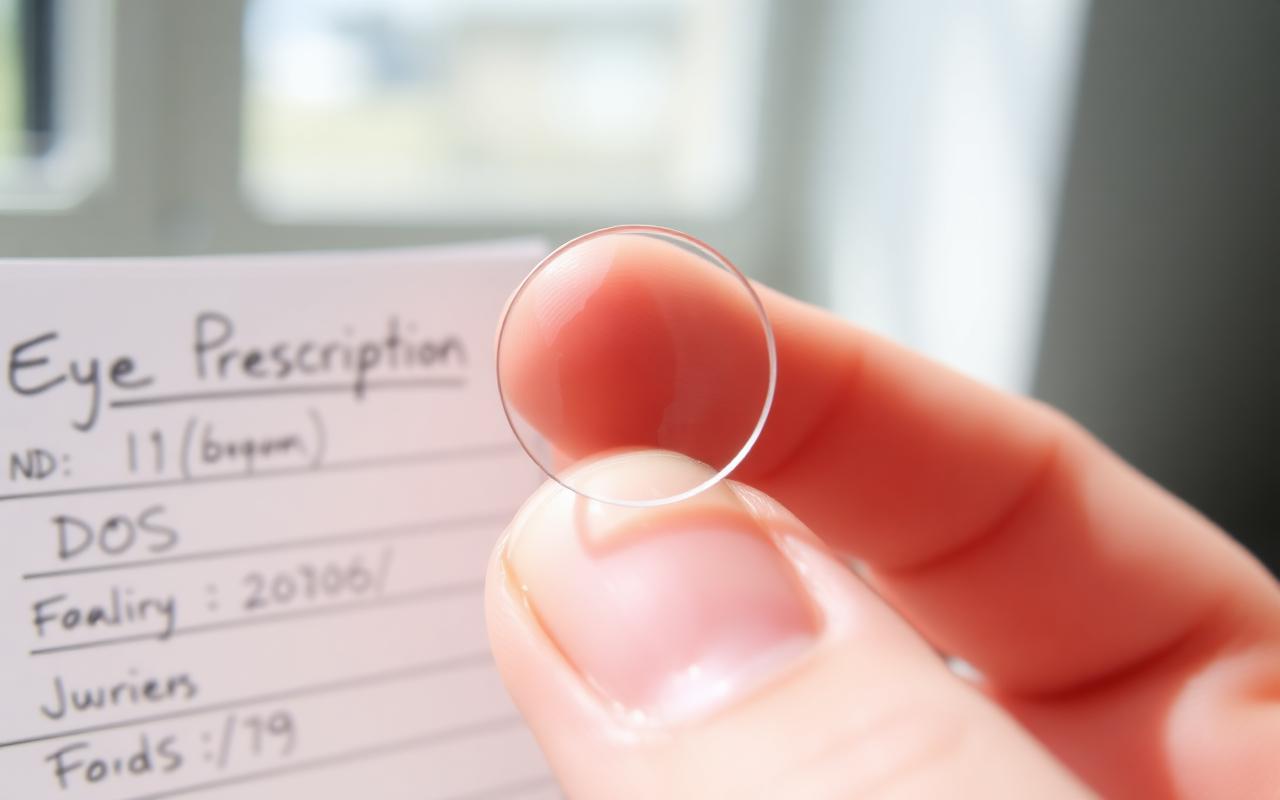
If you've ever looked at a contact lens prescription and felt like you were reading a foreign language, you're not alone. Canadian eye care providers use a short list of abbreviations — OD, OS, PWR, BC, DIA, and a few more for specialty lenses — to tell you exactly which lens your eyes need. Understanding them takes about ten minutes, and it makes ordering contact lenses online far less stressful.
This guide walks through every field you'll see on a Canadian contact lens prescription, explains the difference between a glasses prescription and a contact lens prescription, and shows you what to check before you place an order.
Glasses prescription vs. contact lens prescription
A glasses prescription and a contact lens prescription are not interchangeable. Glasses sit about 12 mm in front of your eye; contact lenses rest directly on the surface of your cornea. That distance changes the optical power your eye needs, so your contact lens power is often slightly different from your glasses power — especially at higher prescriptions.
A contact lens prescription also specifies the brand, base curve, and diameter — values that glasses prescriptions don't include. Always order from your contact lens prescription, never from your glasses one.
What every abbreviation means
OD and OS — your right and left eye
OD stands for oculus dexter, Latin for right eye. OS stands for oculus sinister, Latin for left eye. Some prescriptions also use OU (oculus uterque) when both eyes share the same values. Your prescription will list each eye on its own row, because the two eyes almost always need slightly different lenses.
PWR or SPH — power / sphere
Power (also written PWR, SPH, or D for diopters) is the strength of correction your eye needs. A minus sign (e.g. −2.75) means you're nearsighted (myopic); a plus sign (+1.25) means you're farsighted (hyperopic). The further from zero, the stronger the lens. Contact lens powers typically come in 0.25-diopter steps up to ±6.00, then jump to 0.50-diopter steps.
BC — base curve
Base curve (BC) describes how curved the back of the lens is, in millimetres. A typical range is 8.3 to 9.0 mm. Your eye care provider matches the base curve to the curvature of your cornea so the lens sits comfortably and moves correctly when you blink. Always order the exact base curve on your prescription — even a small mismatch can affect comfort and vision.
DIA — diameter
Diameter (DIA) is the total width of the lens, in millimetres — usually between 13.8 and 14.5 mm for soft lenses. Like base curve, the diameter is fitted to your eye and shouldn't be substituted. If you switch brands, the same nominal diameter from a different manufacturer can sit slightly differently, so brand changes should be discussed with your optometrist.
CYL and AXIS — for astigmatism
If you have astigmatism, your prescription includes two extra values. Cylinder (CYL) measures the amount of astigmatism correction, written as a negative number such as −0.75 or −1.75. Axis is an angle from 1° to 180° that tells the lens how to orient itself on your eye. Astigmatism lenses are called toric lenses and are sold by power, base curve, diameter, cylinder, and axis together.
ADD — for multifocal and presbyopia
If you need help focusing on close objects (most people after age 40), your prescription may include an ADD value such as +1.00, +1.50, or +2.50. Many multifocal contact lens brands use simplified labels — LOW, MED, and HIGH — that map to ranges of ADD power. Your prescription will tell you which to choose.
Brand and expiry date
Your prescription will name a specific brand and product (for example, Acuvue Oasys 1-Day or Biofinity). Contact lens prescriptions in Canada are typically valid for one to two years from the date issued — your provincial college of optometrists sets the rule, and your prescriber writes the expiry date on the document.
Quick rule: order the brand, power, base curve, diameter — and for toric or multifocal lenses, the cylinder/axis or ADD — exactly as written. Substitutions need a new fitting.
Sample Canadian contact lens prescription
A typical Canadian contact lens prescription for a single-vision wearer might look like this:
- Brand: Acuvue Oasys 1-Day with HydraLuxe
- OD (right eye): PWR −2.75 · BC 8.5 · DIA 14.3
- OS (left eye): PWR −3.00 · BC 8.5 · DIA 14.3
- Expiry: 12 months from prescribed date
Common mistakes when ordering online
- Using a glasses prescription instead of a contact lens prescription.
- Picking the wrong eye — OD is right, OS is left.
- Substituting the base curve or diameter to 'match' a different brand.
- Forgetting cylinder and axis on a toric prescription.
- Ordering after the expiry date — Canadian regulations require a current prescription.
What to do if you're unsure
Don't guess values. If anything on your prescription is unclear — handwriting, abbreviations, or differences from your last order — upload a clear photo or PDF of the prescription when checking out, or contact our support team before ordering.
Send us a photo or PDF and we'll match it to the right product before your order ships.
Upload your prescriptionFind your brand, schedule, and lens type — daily, monthly, toric, multifocal, or coloured.
Browse all contact lensesFrequently asked questions
Can I order contacts with my glasses prescription?+
No. Contact lens prescriptions include base curve, diameter, and brand — values that don't appear on a glasses prescription. Always use a current contact lens prescription from a Canadian eye care provider.
How long is a contact lens prescription valid in Canada?+
Validity is set by your provincial college of optometrists. One to two years is typical; the exact expiry date is written on the prescription.
What does OD and OS mean on a contact lens prescription?+
OD is oculus dexter (right eye), OS is oculus sinister (left eye). OU means both eyes share the same values.
Can I change the base curve or diameter when switching brands?+
No — base curve and diameter are fitted by your provider to your specific eye. Switching brands requires a new fitting with your optometrist.
What if my prescription is expired?+
You'll need a new eye exam in Canada to renew it. We cannot ship contact lenses against an expired prescription.
The information on this site is for general purposes only and doesn't replace the advice of your eye care professional.